

Industrial Cutting Tools for Precision Manufacturing Guide
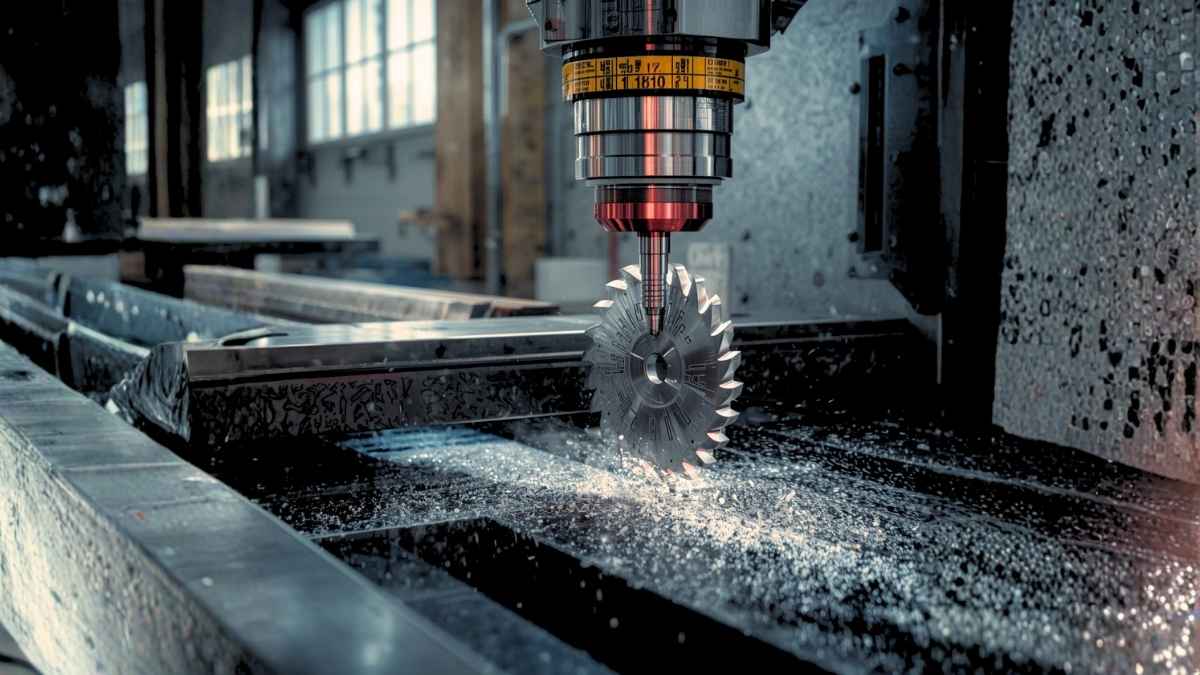
Precision manufacturing demands absolute repeatability. Whether you are machining automotive components in Pune or aerospace parts in Bengaluru, the integrity of your finished product relies entirely on the quality of your industrial cutting tools for precision manufacturing. A minor deviation in tool geometry or material hardness can lead to scrapped parts, machine downtime, and costly rework. This guide cuts through the technical noise to provide practical, actionable advice for procurement managers and workshop owners operating in the Indian industrial supply market. We will explore the tooling solutions that deliver micron-level accuracy while optimising tool life and reducing the cost-per-part in INR terms.
Why Precision Tooling Defines Modern Manufacturing Success
The landscape of manufacturing equipment in India has evolved dramatically with the rise of “Make in India” initiatives. Gone are the days when a generic high-speed steel (HSS) blade was sufficient for every job. Today’s industrial tools are engineered with complex geometries, advanced coatings, and substrate materials designed to handle extreme heat and pressure. When we discuss industrial cutting tools for precision manufacturing, we are talking about tools that remove material with minimal kerf loss and maximum surface finish integrity.
The Impact on Operational Efficiency
Poor tool selection is the hidden culprit behind excessive vibration and chatter on the shop floor. This chatter not only produces a rough finish but also significantly shortens the lifespan of your machine tool spindles and bearings. By investing in premium tooling solutions, factory managers in India can observe a measurable decrease in power consumption on CNC machines. Sharper tools require less force to cut, which means your drives and motors work less. This translates to lower electricity bills and extended machinery service intervals. Furthermore, consistent tool wear allows for predictive maintenance scheduling. You can swap inserts or blades during planned downtime rather than reacting to a catastrophic failure in the middle of a production run, saving thousands of rupees in emergency repair costs.
Meeting Tighter Tolerances
Modern engineering drawings often specify tolerances of ±0.005 mm or tighter. Achieving this requires more than just a rigid machine setup; it requires a cutting edge that remains sharp and stable under thermal load. For instance, carbide tooling maintains its hardness at temperatures where HSS would soften and deform. This thermal stability is non-negotiable in high-speed precision machining environments. When selecting industrial tools in the Indian market, you must consider the coefficient of thermal expansion of both the tool and the workpiece to ensure the final dimension matches the CAD model exactly after cooling.
Core Types of Industrial Cutting Tools for Precision Machining
To navigate the vast world of factory tools, it is helpful to categorise them by their primary function and machine compatibility. While milling cutters and lathe inserts dominate CNC discussions, we must not overlook the foundational role of sawing and parting operations. Selecting the wrong type here creates downstream inefficiencies for the entire cell.
Bandsaw Blades – The Workhorse of Material Preparation
Before a billet of metal ever touches a 5-axis mill, it must be cut to size. The accuracy of this cut dictates how much material must be faced off later. A rough, wandering cut from a dull blade can add 2-3mm of extra stock removal on the mill, wasting time and tool life. This is where high-quality bi-metal blades excel. They combine a flexible spring steel backer with a hardened high-speed steel tooth tip. This design absorbs the shock of cutting irregular shapes without snapping while providing a razor-sharp cutting edge. For Indian workshops running older lathe machines or newer CNC saws, the bi-metal blade offers the best return on investment.
Indexable Carbide Inserts
For lathe work and face milling, carbide inserts are the standard for precision manufacturing. The key is selecting the correct chip breaker geometry. For finishing passes, a sharp, positive rake angle produces a mirror finish. For roughing, a stronger, negative rake insert can handle interrupted cuts and heavy scale. The coating on the insert—be it Titanium Nitride (TiN) or Aluminium Titanium Nitride (AlTiN)—acts as a thermal barrier, allowing for faster spindle speeds.
Solid Carbide End Mills
These are essential for profiling complex 3D surfaces. The number of flutes directly correlates to the application. A 2-flute end mill is ideal for aluminium and non-ferrous metals where chip evacuation is critical to prevent re-cutting chips. A 4 or 5-flute end mill is better suited for hardened steels where a stronger core and higher feed rate are required.
Material Compatibility and Cutting Parameter Reference
Selecting the correct machine tools is only half the battle; matching the tool to the workpiece material is the other. Using a tool designed for aluminium on a block of titanium will result in immediate tool failure and potential damage to the workpiece. The table below serves as a quick reference guide for common scenarios in the industrial supply chain, with indicative price ranges in Indian Rupees (INR).
Mandatory Table: Tool Selection by Material and Application (INR)
| Tool Type | Best Use Case | Material Compatibility | Indicative Price Range (INR) |
| Bi-Metal Bandsaw Blade | Cutting structural steel, solid bar stock, and tubing. | Mild Steel, Stainless Steel, Aluminium, Brass. | ₹2,500 – ₹9,500 |
| Carbide Insert (AlTiN Coated) | High-speed turning of hardened steels and superalloys. | Alloy Steel (>45 HRC), Inconel, Titanium. | ₹900 – ₹2,800 |
| Solid Carbide End Mill (4-Flute) | Profile milling and slotting in steel. | Carbon Steel, Tool Steel, Cast Iron. | ₹1,800 – ₹12,000 |
| HSS Jobber Drill Bit | General purpose drilling in low volume production. | Mild Steel, Wood, Plastic, Non-Ferrous. | ₹200 – ₹1,600 |
| Diamond Grinding Wheel | Achieving sub-micron surface finishes on ultra-hard materials. | Tungsten Carbide, Ceramics, Glass. | ₹6,500 – ₹40,000 |
The Critical Importance of Tooth Pitch (TPI) in Sawing
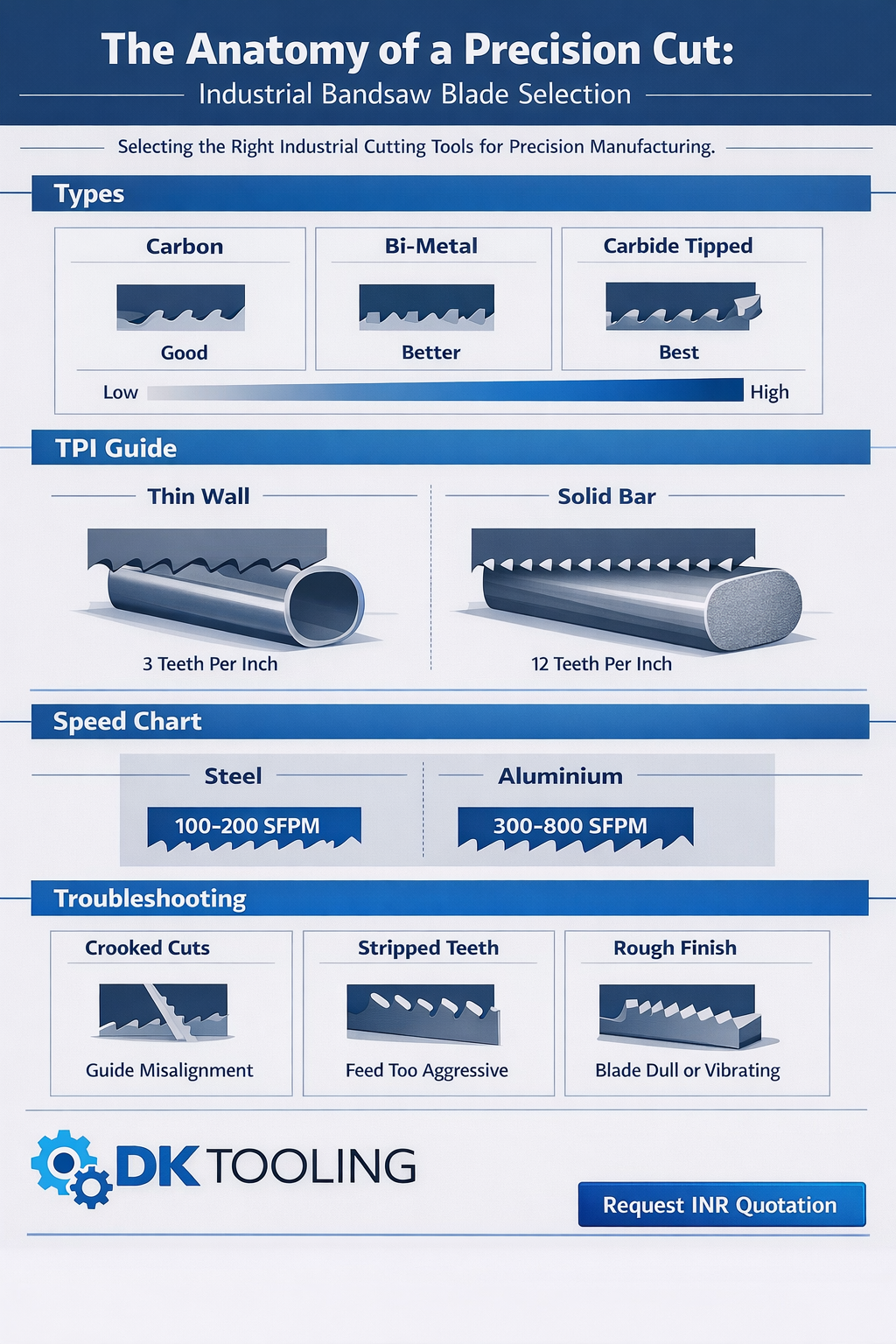
One of the most overlooked aspects of sawing operations is the variable Tooth Per Inch (TPI) specification. In the realm of industrial cutting tools for precision manufacturing, a one-size-fits-all TPI does not exist. The rule is simple: you must have a minimum of three teeth engaged in the material cut at all times.
Managing Chip Load
If you are cutting thin-wall tubing with a coarse blade (e.g., 4/6 TPI), the teeth will straddle the wall thickness. This leads to the tooth striking the edge of the material like a hammer, stripping teeth from the band. Conversely, using a fine blade (e.g., 18 TPI) on a 6-inch solid round bar will result in the gullets (the space between teeth) filling with chips before the tooth exits the cut. This increases friction, generates heat, and work-hardens the material surface, making subsequent passes difficult. For general precision machining work, a variable pitch blade (e.g., 10/14 TPI) offers an excellent compromise, reducing harmonic vibration and providing a smoother cut across a range of profiles.
Breaking In a New Blade
A common, yet expensive, mistake in Indian workshops is running a new carbide or bi-metal blade at full speed immediately. The tooth tip is micro-sharp. Running it at the normal feed rate will cause micro-chipping of the cutting edge. To maximise tool life and protect your factory tools investment, you should run the blade at approximately 50% of the normal feed rate for the first 50-100 square inches of material cut. This gently hones the edge, resulting in a blade that will actually last up to 30% longer than one run hard from the first cut.
Recommended Product: Precision Bi-Metal Bandsaw Blade
Product Name: Powertec 111-Inch Bi-Metal Bandsaw Blade (1/2 x 14 TPI)
Short Description:
Engineered specifically for non-ferrous precision cutting. This 111-inch blade features an M42 cobalt high-speed steel tooth edge welded to a fatigue-resistant alloy backer. The 14 TPI configuration delivers exceptionally clean, burr-free cuts in aluminium and brass profiles, reducing secondary finishing operations on your precision machining parts. Ideal for Indian workshops cutting brass electrical components and aluminium extrusion profiles.
CTA Button Text: View INR Pricing & Details
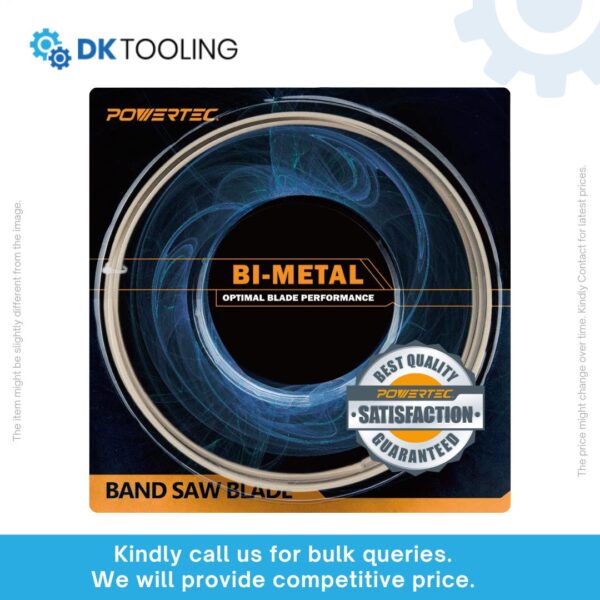
Industrial Grade Bi-Metal Bandsaw Blades High Performance Non-Ferrous Metal Cutting for Rikon 10-325 and Craftsman 14″ Saws
Long-lasting Bi-metal blade for 14-inch saws, ideal for aluminum and brass.
Precision Cutting Starts Here: Bi-Metal Bandsaw Blades for the Serious Hobbyist and Pro
If you own a Rikon 10-325 or a Craftsman 22440 14″ bandsaw, you know the frustration of a dull blade ruining a perfect piece of aluminum. There is nothing worse than blade drift, gummed-up teeth, or a sudden snap right in the middle of a resaw. That’s where the POWERTEC 13380 steps in. This isn’t just a piece of coiled metal; it is an Industrial Grade Bi-Metal Bandsaw Blade meticulously crafted to turn your wood-cutting bandsaw into a precise, non-ferrous metal slayer. Whether you are fabricating brackets, cutting knife scales, or shaping intricate brass hardware, this 1/2″ wide, 14 TPI blade is the most critical upgrade you can make to your workshop today.
Product Overview: The POWERTEC 13380 Advantage
This listing is for one (1) High Performance Bi-Metal Bandsaw Blade, model 13380. It measures 111 inches in length, 1/2 inch in width, and features a 14 TPI (Tooth Per Inch) configuration. Unlike carbon steel blades that dull after a single project on aluminum, this blade is constructed using a premium M42 High-Speed Steel tooth edge electron-welded to a flexible alloy steel backer. This hybrid construction allows the blade to withstand the abrasive nature of non-ferrous metals while maintaining enough flex to wrap around a 14″ wheel without cracking.
Why This Bi-Metal Bandsaw Blade Outperforms Carbon Steel
It is a common mistake to use a wood blade for metal. You might get away with it once on soft brass, but the heat and friction destroy the temper of the teeth instantly. Here is why making the switch to a true Bi-Metal Bandsaw Blade is a non-negotiable for your specific saw models:
Dramatically Extended Blade Life: The M42 HSS edge maintains its hardness at high temperatures. While a carbon blade dulls after 10 linear feet of aluminum, this blade stays sharp for hundreds of feet. You spend less money replacing blades and less time re-setting the tension on your saw.
Vibration-Free Finish: The 14 TPI count is the “Goldilocks” zone for non-ferrous stock between 1/8″ and 3/4″ thick. It engages enough teeth in the cut to prevent the blade from “gullet loading” and chattering. The result is a surface finish that requires minimal filing or sanding.
Pinpoint Accuracy: The 1/2″ width offers the perfect balance of curve-cutting agility and straight-line stability. It resists deflection (blade drift) far better than a 1/4″ blade when resawing thicker aluminum bar stock.
Perfect Fit Compatibility: Designed to the exact OEM specs for Rikon 10-325, 10-326, 10-324TG, and Craftsman 22440. There is no guesswork. This 111-inch length fits these specific 14″ saws perfectly, ensuring proper tension without maxing out your spring.
Precision Applications: What Can You Cut?
This Bi-Metal Bandsaw Blade is optimized for the following materials and tasks:
Aluminum: Cutting plate, bar stock, angle iron, and tubing (6061 and 7075 alloys).
Brass & Copper: Ideal for hobbyists making jewelry, model parts, or plumbing components.
Plastics & Phenolics: Delivers clean, non-melted edges on acrylic, Delrin, and G10/FR4 (garolite) circuit board material.
Wood Resawing (Secondary Use): While optimized for metal, the 14 TPI configuration also produces a surprisingly smooth cut in dense hardwoods like Maple and Walnut.
Why Settle for Less? The Premium Edge Comparison
When you search for Bi-Metal Bandsaw Blades, you’ll find cheaper import options. Here is the difference between a generic blade and the POWERTEC 13380:
| Feature | Generic Carbon Steel Blade | POWERTEC 13380 Bi-Metal Blade |
|---|---|---|
| Edge Material | Spring Steel | M42 Cobalt High-Speed Steel |
| Cutting Life (Aluminum) | 1-2 Projects | 50+ Projects |
| Heat Tolerance | Loses temper at 400°F | Maintains hardness at 1100°F |
| Set Consistency | Uneven set causes drift | Precision milled set for true tracking |
| Rikon 10-325 Fit | May be +/- 1″ off | Exact 111″ Length |
Built to Last: The M42 High-Speed Steel Difference
The core of this product’s durability lies in the metallurgy. The M42 alloy contains approximately 8% Cobalt. Cobalt is the secret ingredient that allows the cutting edge to resist softening under the intense friction generated when cutting metal. The flexible alloy steel backer absorbs the shock and cyclic fatigue of bending around the 14-inch wheels millions of times. This combination means the blade will snap from fatigue long before the teeth get dull—a testament to true industrial grade construction.
Frequently Asked Questions (FAQs)
1. Will this Bi-Metal Bandsaw Blade fit my Rikon 10-326 exactly?
Answer: Yes. The Rikon 10-325, 10-326, and 10-324TG all utilize the exact same 111-inch blade length. This is a direct OEM replacement size. You do not need to adjust the tension spring beyond the normal indicator marking for this blade width.
2. I want to cut steel. Can I use this 14 TPI blade?
Answer: No. This specific blade is designated for Non-Ferrous metals only (Aluminum, Brass, Copper, Bronze). Ferrous metals (Steel, Iron, Stainless) require a much slower blade speed and a different tooth geometry (usually 18-24 TPI variable pitch). Attempting to cut steel with this 14 TPI blade will instantly strip the teeth.
3. What thickness of aluminum is best for this 14 TPI blade?
Answer: The “Rule of Thumb” for a 14 TPI blade is a minimum material thickness of 1/8″ (3mm). This ensures at least 3 teeth are in the cut at all times. You can cut up to 1″ thick aluminum plate comfortably with this blade. For sheet metal thinner than 1/8″, a finer 18-24 TPI blade is recommended to prevent snagging.
4. Is this blade weld joint smooth?
Answer: Absolutely. POWERTEC uses a precision butt-weld process with an annealing step. The joint is ground flush to the parent material. You will not hear a “tick, tick, tick” sound as the weld passes through the guide blocks, which is a common problem with lower-quality welded bands.
5. Do I need to “break in” a Bi-Metal Bandsaw Blade before heavy cutting?
Answer: Yes, this is a critical step for maximizing blade life. For the first 5-10 minutes of use, reduce your feed pressure by about 50% and make a few cuts in a soft material like aluminum scrap or even hard plastic. This gently hones the razor-sharp factory edge and prevents microscopic chipping of the teeth tips when they first hit the material.
The Bottom Line for Your Workshop
Stop treating your precision bandsaw like a rough-cut machine. Whether you’re fabricating parts for a drone, restoring a vintage motorcycle, or just need clean cuts in aluminum plate, the POWERTEC 13380 Bi-Metal Bandsaw Blade is the upgrade that pays for itself in saved time and saved material. Add this 1-Pack to your cart and experience the difference a professional-grade consumable makes in your Rikon 10-325 or Craftsman 22440.
The Real-World Impact of Tooling Quality on Your INR Budget
The conversation in the tool crib often revolves around the upfront invoice price of a box of inserts or a single blade. However, experienced factory managers and procurement buyers in India understand that industrial tools represent a variable cost driver. The true metric is Cost Per Cut or Cost Per Part.
“Selecting the correct industrial tool improves efficiency, safety, and machine lifespan. I’ve seen Indian workshops reduce their annual consumable spend by nearly 15% simply by switching from generic carbon blades priced at ₹1,000 to application-specific bi-metal tooling priced at ₹4,500. The initial investment is higher, but the reduction in downtime and scrapped material provides an ROI measured in weeks, not months.”
— Senior Manufacturing Process Engineer, DK Tooling Solutions India
Calculating Total Cost of Ownership (TCO) in INR
Consider a scenario common in the Indian industrial supply market:
- Generic Carbon Blade: Cost ₹1,200. Lasts for 50 cuts. Cost per cut: ₹24.00.
- Premium Bi-Metal Blade: Cost ₹4,500. Lasts for 300 cuts. Cost per cut: ₹15.00.
Labour Impact: Changing a generic blade 6 times more often consumes approximately 1.5 hours of skilled labour time. At a burdened labour rate of ₹400/hour, the generic blade costs an additional ₹600 in labour alone. When you factor in the cost of machine idle time and the risk of scrapping a ₹5,000 workpiece due to a wandering cut, the “cheap” blade is actually the most expensive item in your inventory.
Related Products You May Also Need:
To maintain a safe and efficient shop floor, we recommend pairing your cutting tools with these essential support items available at DK Tooling:
- Band Saw Coolant Concentrate: Prolongs blade life by reducing heat build-up during high-volume precision machining. (INR Price on Request)
- Chip Brush and Magnetic Sweeper: Keeping the work area clear of swarf prevents blade snagging and maintains cut accuracy.
- Digital Tachometer: Verify your machine’s actual blade speed (SFPM) matches the tool manufacturer’s recommendation.
While selecting the correct blade is vital, it is just one component of a broader efficiency strategy. For a deeper dive into the equipment that holds these tools, you might find our Complete Guide to Industrial Tools extremely useful. If you are currently sourcing new machinery to run these high-performance blades, understanding the landscape of Top 10 Industrial Tools Manufacturing Companies in India can provide strategic context for your procurement decisions. Furthermore, for those in the market for complementary factory tools, we have a detailed Industrial Tools & Equipment Buying Guide that covers everything from drills to safety gear.
Essential Buying Checklist for Industrial Buyers in India
Before finalising your next purchase order for tooling solutions, run through this quick checklist to ensure you have covered all bases for your precision manufacturing requirements:
- GST & Billing: Is the supplier GST compliant and providing proper tax invoices for input credit?
- Lead Time: Is the stock held in a warehouse in India (Mumbai/Pune/Chennai) or does it require 4-6 weeks import lead time?
- Material Grade Verification: Have you confirmed the specific alloy grade (e.g., 6061 Aluminium vs. EN8 Steel)?
- Runout Specification: For rotating tools, is the specified runout tolerance less than 0.01mm?
- After-Sales Support: Does the supplier offer technical application support for troubleshooting?
Don’t Let the Wrong Tool Eat Your Margin
Precision manufacturing requires precise tooling. Whether you are cutting Inconel or mild steel, we can help you optimise your process and reduce your INR spend per component.
Get detailed SFPM charts, TPI recommendations, and cross-reference guides for all major machine brands.
Speak to a tooling specialist about volume discounts on bandsaw blades and carbide inserts. Minimum order value ₹15,000.
FAQs
1. What are the key differences between industrial cutting tools for precision manufacturing and standard workshop tools?
The primary distinction lies in tolerance and metallurgy. Standard workshop tools, often found in local hardware markets, are designed for versatility and low cost (often under ₹500). They utilise basic High-Speed Steel (HSS) with wider manufacturing tolerances. In contrast, industrial cutting tools for precision manufacturing utilise micro-grain carbide substrates or M42 Cobalt steel. These materials are ground to geometric accuracies measured in microns. While a standard blade might wander during a cut, a precision bi-metal blade ensures straightness and squareness, which is critical for subsequent CNC operations. This precision eliminates the need for secondary finishing passes, saving considerable time and resources in a production environment.
2. How do I select the correct TPI (Teeth Per Inch) for my bi-metal bandsaw blade?
Selecting the correct TPI is governed by the cross-section and hardness of the material you are sawing. The fundamental rule is “Constant Chip Load.” You should always have a minimum of 3 teeth engaged in the workpiece. For thin-wall tubing or sheet metal (under 3mm thick), a fine pitch of 18-24 TPI is required to prevent tooth stripping. For large solid rounds (over 100mm diameter), a coarse pitch of 2/3 or 3/4 TPI is necessary to provide adequate gullet space for chip clearance. For general industrial tools shops in India cutting mixed solids and profiles, a variable pitch blade (e.g., 10/14 TPI) is the most efficient and versatile choice.
3. Why is my carbide insert chipping prematurely during precision machining operations?
Premature chipping is almost always a symptom of instability or incorrect engagement. The first suspect is machine rigidity; check for loose gibs or worn spindle bearings on your Indian-made or imported lathe. Carbide is extremely hard but brittle. If the tool is not held rigidly, micro-vibrations will act like a tiny jackhammer on the cutting edge. The second suspect is the entry condition of the cut. If you are milling a surface with a hard scale (e.g., flame-cut steel edge), that first impact can shatter the insert. In this case, you should program a “roll-in” entry arc. Finally, ensure the coolant flow is adequate; thermal shock from intermittent coolant can cause hairline cracks in the carbide structure.
4. What is the benefit of a bi-metal blade over a carbon steel blade for cutting structural steel?
The benefit is exponential in terms of tool life and cut quality. Carbon steel blades are monolithic; the teeth are cut from the same piece of steel as the body. When heat builds up, the entire blade softens. A bi-metal blade uses a flexible, fatigue-resistant alloy steel backing strip with High-Speed Steel (HSS) teeth welded to the edge. This creates a blade that is flexible yet has teeth that maintain hardness up to 600°C. For tooling solutions involving structural steel I-beams or large rounds, a bi-metal blade will outlast a carbon blade by a factor of 10 to 1, providing a far lower cost-per-cut in INR terms.
5. How does cutting speed (SFPM) affect the surface finish in precision manufacturing?
Surface Feet Per Minute (SFPM) dictates the temperature at the shear zone where the chip is formed. If SFPM is too low, the material tears rather than shears, leaving a rough, torn finish. If SFPM is too high for the given tool coating, the material can gall or weld itself to the cutting edge (Built-Up Edge), causing scoring on the workpiece surface. Achieving a quality finish requires hitting the “sweet spot” where the material softens just enough to shear cleanly without melting or sticking. For example, machining 304 Stainless Steel requires a lower SFPM than Aluminium because Stainless work-hardens and retains heat.
6. What safety precautions are essential when using industrial cutting tools in a factory environment?
Safety begins before the spindle turns. First, ensure all guards and interlocks are functional and in place; never bypass a door interlock for convenience. Second, eye protection is non-negotiable, especially during interrupted cuts where hot chips can fly significant distances. Third, proper swarf management is critical. Long, stringy chips from ductile materials can be razor-sharp; use pliers or a hook tool to clear them, never your bare hands. Fourth, ensure the workpiece is securely clamped. In precision machining, a part moving just 0.050mm during a cut can cause a catastrophic tool explosion.
7. How can I extend the lifespan of my industrial cutting tools and reduce overall tooling costs?
Extending tool life involves managing the “Triangle of Tribology”: Friction, Heat, and Lubrication. Maintain the correct coolant concentration; too lean causes rust and friction, too rich reduces cooling capacity. Use a refractometer to check concentration weekly. Secondly, adhere strictly to “Break-In” procedures for new edges (running at 50-60% speed for the first few parts). Third, implement a tool life management system. Use the machine controller to track “Cut Time” or “Parts Cut” and replace tools based on a predictable schedule before they fail. This prevents the cost of reworking or scrapping a high-value component due to a dull tool.
8. Where can I find reliable suppliers for industrial tools and tooling solutions in India?
Reliability in industrial supply is defined by consistency and technical support. Look for suppliers who offer detailed technical datasheets and GST-compliant invoicing. A reliable partner, like DK Tooling, provides cross-reference guides and application advice specific to your manufacturing equipment. Check if the supplier holds stock locally in major industrial hubs (Pune, Ahmedabad, Coimbatore) or if they drop-ship from overseas (which adds lead time and customs complexity). For critical spares, local availability of high-quality industrial tools is paramount. Reviewing resources like the Industrial Tools & Equipment Buying Guide is an excellent starting point for vetting potential partners in the precision manufacturing space.
Posts Widget
- 1

- 2
- 3
- 4




dk-tooling-logo-horizontal-inverse
DK Tooling and Industrial Solution
Welcome to DK Tooling, your trusted partner in precision tooling and manufacturing solutions. With decades of experience in the industry, we specialize in providing high-quality, reliable tooling solutions for a wide range of sectors, including automotive, aerospace, medical, and consumer goods.
Copyright 2025 © Partdo WordPress Theme. All right reserved. Powered by KLBTheme.