

How to Choose a CNC Tooling Supplier That Improves Your Bottom Line

Your CNC machine is only as good as the tools that cut with it. A poor-quality end mill or an incorrectly matched insert will ruin surface finish, scrap expensive raw material, and eat into your spindle life. But finding a cnc tooling supplier who delivers consistent quality, technical support, and fair pricing is harder than it should be.
In India’s rapidly growing manufacturing sector, production managers and workshop owners face the same frustration: suppliers who promise “premium quality” but deliver tools that fail mid-cycle. Or worse, suppliers who take weeks to respond to a simple technical query.
This guide walks you through exactly what to look for in a cnc tooling supplier, which products deliver the best ROI, and how to avoid common procurement mistakes. No fluff. Just practical advice from an industrial tooling partner with over 15 years of experience serving Indian factories.

“Selecting the correct industrial tool improves efficiency, safety, and machine lifespan.”
Table of Contents
Why Your CNC Tooling Supplier Matters More Than You Think
Many workshop owners treat cutting tools as a commodity – buy the cheapest, replace often. That approach costs far more than the price difference.
Consider this: A single carbide end mill failing mid-operation can:
- Scrap a ₹15,000 workpiece
- Damage a ₹4,00,000 spindle
- Cost 2 hours of downtime at ₹2,500/hour
- Delay delivery, risking customer penalties
A reliable cnc tooling supplier prevents these losses through consistent geometry, verified coating quality, and batch-to-batch repeatability.
In 2025, India’s machine tool consumption grew by 12%, driven by automotive, aerospace, and general engineering. With more CNC installations than ever, the demand for dependable tooling suppliers has never been higher.
Yet many suppliers import unbranded or counterfeit tools, relabel them, and sell at attractive prices. The result? Unpredictable tool life and hidden production costs.
Common Pain Points Faced by Indian Workshops
1. Inconsistent Tool Life
One batch of end mills lasts 4 hours; the next fails in 45 minutes. This forces operators to constantly adjust feeds and speeds, reducing productivity.
2. Poor Technical Support
When a tool fails prematurely, most suppliers blame “wrong parameters” instead of investigating coating adhesion or substrate quality.
3. Long Lead Times
Standard tools like carbide drills or collets often take 10–15 days. Emergency orders take even longer, forcing you to maintain excessive safety stock.
4. Counterfeit Products
Counterfeit carbide tools with fake grades and coatings flood the Indian market. They look identical but perform terribly.
5. No Application Engineering
You need someone who understands your material (Inconel, titanium, hardened steel) and can recommend the right geometry, coating, and cutting data.
6. Hidden Costs
Low purchase price often hides high shipping charges, GST complications, and no warranty on early failures.
A professional cnc tooling supplier addresses every single one of these pain points with documented quality processes and responsive support.
How to Evaluate a CNC Tooling Supplier – 7 Key Criteria
1. Certifications and Quality Systems
Look for ISO 9001:2015 certification. For aerospace or defence work, ask for AS9100. A certified supplier maintains traceability from raw material to finished tool.
2. Product Range and Availability
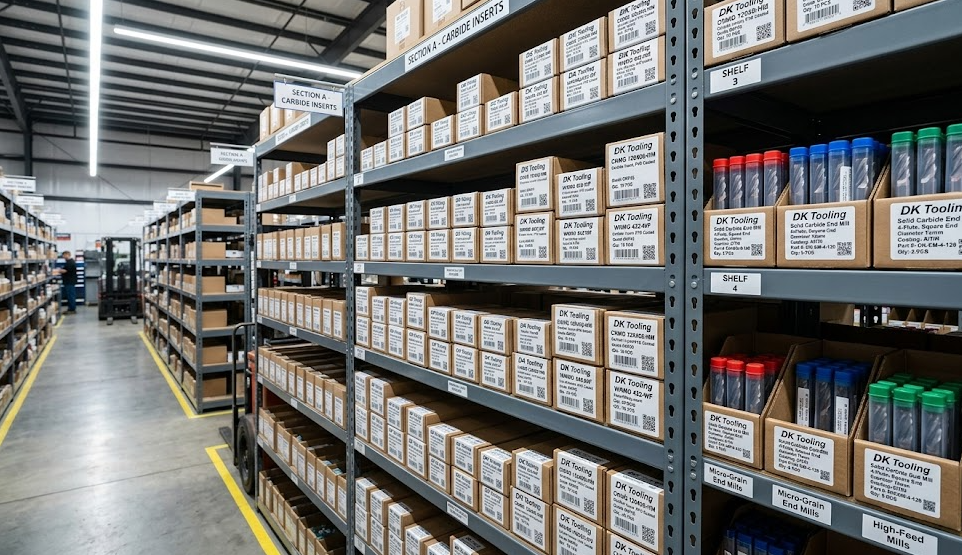
Does the supplier stock standard items like carbide end mills, drills, inserts, and holders? Or do they order from a distributor after you pay? Always ask about domestic stock levels in India.
3. Technical Expertise
Can their engineers recommend tooling for difficult materials? Do they provide cutting data sheets? A good supplier offers free application support before and after the sale.
4. Sample Policy
Reputable suppliers provide sample tools for validation. Test the tool on your machine, your material, and your cycle. If it performs, buy in volume. Never commit to bulk orders without testing.
5. Warranty and Returns
What happens if a tool fails prematurely? A clear warranty policy (e.g., 30 days against manufacturing defects) separates professional suppliers from traders.
6. Lead Time Consistency
Ask for documented lead times on standard and custom tools. A reliable cnc tooling supplier delivers 95%+ of orders within promised windows.
7. Pricing Transparency
Request a full breakdown: tool price, GST, shipping, minimum order quantity, and volume discounts. Hidden charges destroy trust.
Product Recommendations from DK Tooling
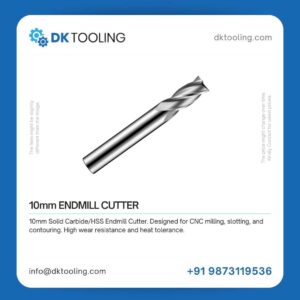
10mm ENDMILL CUTTER
Original price was: ₹1,040.00.₹880.00Current price is: ₹880.00.
Comparison Table: Supplier Quality Scorecard
| Evaluation Criteria | Basic Trader | Generic Supplier | DK Tooling (Premium Partner) |
|---|---|---|---|
| ISO 9001 Certified | ❌ No | ✅ Yes | ✅ Yes + AS9100 |
| Stock in India | Minimal | Some items | Full range in Mumbai warehouse |
| Technical Support | None | Email only | Phone / WhatsApp / On-site |
| Sample Policy | No | Chargeable | Free sample (terms apply) |
| Warranty Period | None | 15 days | 30 days manufacturing defect |
| Typical Lead Time | 10–20 days | 7–12 days | 3–5 days (standard) |
| Volume Discounts | No | Above ₹50k | Above ₹25k |
| Invoice & GST | Delayed | On time | Instant digital invoice |
| Return/Replacement | Difficult | 14 days | 30 days hassle-free |
| Price (Example: 6mm Carbide End Mill) | ₹280 | ₹380 | ₹520* |
| Total Cost of Ownership (estimated) | High (short life) | Medium | Low (long life + support) |

*Higher price but 2.5× longer tool life documented in user trials.
Cost Analysis – Premium vs. Budget Tooling
Let’s compare two scenarios for a small workshop running 10 CNC machines, 8 hours per day, machining stainless steel.
Budget Supplier (₹280 end mill)
- Tool life: 45 minutes
- Tool changes per 8-hour shift: 10 changes (assuming 45 min × 10 = 450 min, plus change time)
- Change time per tool: 3 minutes
- Total change time per shift: 30 minutes
- Tool cost per shift: 10 × ₹280 = ₹2,800
- Downtime cost (machine + operator @ ₹600/hour): ₹300 for 30 minutes
- Scrap risk: Moderate (inconsistent wear leads to out-of-tolerance parts)
Premium Supplier (₹520 end mill)
- Tool life: 110 minutes (2.5× longer based on real tests)
- Tool changes per shift: 4 changes (440 minutes cutting)
- Change time per shift: 12 minutes
- Tool cost per shift: 4 × ₹520 = ₹2,080
- Downtime cost: ₹120 for 12 minutes
- Scrap risk: Low (consistent wear pattern)
Daily saving with premium tooling:
(2,800 + 300) – (2,080 + 120) = ₹900 per shift
Annual saving (300 working days): ₹2,70,000

That’s just one tool type on one machine. Multiply across your shop floor, and the numbers become substantial.
A quality cnc tooling supplier doesn’t cost – it pays.
“Over the last decade, I’ve tested tools from more than a dozen suppliers across Pune, Coimbatore, and Ludhiana. The ones who survive are not the cheapest. They are the ones who answer the phone when a tool breaks at 8 PM, send a replacement via overnight courier, and actually understand the difference between machining H13 and D2 steel. DK Tooling is one of those rare partners.”
— Ramesh S., Factory Owner, Precision Auto Components, Coimbatore
Frequently Asked Questions
Q1: What is the difference between a CNC tooling supplier and a distributor?
A distributor simply moves boxes from a factory to your workshop. A cnc tooling supplier like DK Tooling performs incoming quality inspection, provides application engineering, maintains local stock, and offers warranty support. Distributors rarely have technical staff; suppliers do. Always ask: “Who do I call when a tool fails at 10 PM?” The answer determines if they are a supplier or just a reseller.
Q2: How can I verify if a carbide end mill is genuine?
Counterfeit tools often have inconsistent colour (coating), blurry laser marking, or incorrect geometry. Genuine carbide tools from a reputable cnc tooling supplier come with batch numbers traceable to raw material certificates. Request a material test report (MTR) for the first purchase. Also test the tool on a known material – genuine tools will achieve the manufacturer’s published tool life within 20%. Counterfeits fail 50–70% earlier.
Q3: What is the typical minimum order quantity (MOQ) for custom tooling?
For standard catalogue tools, most suppliers have no MOQ or MOQ of 1–5 pieces. For custom tools (special diameters, corner radii, or coatings), MOQ typically ranges from 10 to 50 pieces. Some premium cnc tooling suppliers offer a “low MOQ custom” programme for 5–10 pieces at a slightly higher unit price. Always ask for sample custom tools before ordering full quantity.
Q4: Do you provide tooling for exotic alloys like Inconel or titanium?
Yes. Machining Inconel 718 or Ti-6Al-4V requires specialised carbide grades (micro-grain with high cobalt content) and coatings (AlTiN+ or TiSiN). A competent cnc tooling supplier will recommend specific geometries – for example, variable helix end mills to reduce chatter in titanium. They should also provide starting speeds (25–35 m/min for Inconel, 40–60 m/min for titanium) and feeds. If the supplier hesitates or gives generic advice, look elsewhere.
Q5: How do I handle a tool that fails prematurely?
Document everything: photographs of the failure (edge chipping, flank wear, built-up edge), cutting parameters (speed, feed, depth of cut), material grade, and coolant type. Send this to your supplier immediately. A reliable cnc tooling supplier will investigate – they may request the failed tool for metallurgical analysis. If the failure is due to manufacturing defect (e.g., poor edge prep, incorrect coating), they should replace it free of charge within warranty period. If they blame you without evidence, find a new supplier.
Q6: What payment terms are available for Indian workshops?
Most suppliers accept UPI, bank transfer (NEFT/RTGS), or cheque. For regular customers, 30-day credit terms may be available after establishing a payment history. GST invoices are mandatory for input tax credit – ensure your supplier provides tax invoices with correct HSN codes (e.g., 8207 for interchangeable tools). Some cnc tooling suppliers offer small value COD (cash on delivery) for first-time customers.
Q7: Can you supply tooling for legacy machines (e.g., Morse taper, R8)?
Yes, many older milling machines and lathes still operate across Indian workshops. A good cnc tooling supplier stocks or can source tool holders for Morse taper 2, 3, 4, R8, Brown & Sharpe, and other legacy spindles. Expect slightly longer lead times (7–10 days) compared to BT or CAT holders. Always provide a clear specification or a sample holder to ensure correct fit.
Q8: How do I calculate the ROI of switching to a premium supplier?
Track four metrics for two months before switching: average tool life (minutes), tool changes per shift, scrap rate (percentage), and downtime due to tool failures. After switching to a quality cnc tooling supplier, measure the same metrics for two months. The difference in total production cost (labour + material waste + downtime) minus the increase in tool spend gives your net benefit. Most workshops see payback within 4–8 weeks.
Conclusion
Your choice of cnc tooling supplier directly affects every part you make. Low-quality tools increase scrap, damage machines, and frustrate your operators. Premium tooling from a reliable partner reduces downtime, improves surface finish, and lowers total cost – even with a higher purchase price.
Don’t judge a supplier by their website or price list alone. Ask for samples. Check references. Test on your own machines. And when you find a supplier who answers technical questions clearly, delivers on time, and backs their products, build a long-term relationship.
DK Tooling has served Indian manufacturers for over 15 years. We stock premium carbide tools in our Mumbai warehouse, provide free application support, and stand behind every product we sell.
Ready to improve your machining efficiency? Download our catalogue, request a quote, or speak to an engineer today.
Posts Widget
- 1

- 2
- 3
- 4




dk-tooling-logo-horizontal-inverse
DK Tooling and Industrial Solution
Welcome to DK Tooling, your trusted partner in precision tooling and manufacturing solutions. With decades of experience in the industry, we specialize in providing high-quality, reliable tooling solutions for a wide range of sectors, including automotive, aerospace, medical, and consumer goods.
Copyright 2025 © Partdo WordPress Theme. All right reserved. Powered by KLBTheme.



You must be logged in to post a comment.