This is DK Tooling and Industrial Solutions. We provide all kind of tooling at your doorstep. Dismiss
May Edition Black Friday! 35% Off Spare Parts.
Free carbon neutral shipping on US orders $50+.
End of Time:
:::
Find the Right Parts Faster
Having the right automotive parts and car accessories will help you to boost your travel comfort and go on the long-distance journey comfortably that you have been planning.
How to Select Best Industrial Components Supplier That Keeps Your Production Running
A missing bearing. A cracked pneumatic fitting. A batch of out-of-tolerance pins. Any of these can stop your assembly line cold. When that happens, your first call isn’t to a designer or a banker – it’s to your industrial components supplier.
In Indian manufacturing, where just-in-time delivery is becoming the norm, the difference between a good supplier and a great one shows up on your production board. Delayed components mean idle workers and missed deadlines. Low-quality parts mean rework, scrap, and unhappy customers.
This guide walks you through exactly what to look for in an industrial components supplier. We cover the products you use every day, the red flags to avoid, and how to build a partnership that improves your bottom line. No jargon. No fluff. Just practical advice from a team that has supplied Indian factories for over 15 years.
How to Select Best Industrial Components Supplier That Keeps Your Production Running 9
“Selecting the correct industrial tool improves efficiency, safety, and machine lifespan.” – The same applies to every component in your production line.
Table of Contents
Why Your Industrial Components Supplier Directly Affects Your Profit
Think of every component as a promise. A bearing promises to rotate without seizing. A fastener promises to hold torque. A seal promises to keep fluid where it belongs.
When a component breaks that promise, you pay more than the replacement cost. You pay for:
Emergency courier charges (often 3–5× normal freight)
Technician overtime to strip and rebuild
Production delays that push back customer deliveries
Potential damage to surrounding parts
A professional industrial components supplier sources from verified manufacturers, performs incoming inspection, and maintains safety stock. They don’t just sell parts – they provide reliability.
India’s industrial components market is projected to grow at 8–10% annually, driven by automotive, machinery, and infrastructure sectors. But growth brings more suppliers into the market – not all of them competent. Your job is to separate the traders from the true partners.
Common Component-Related Headaches in Indian Workshops
1. Inconsistent Dimensions
One batch of pins fits perfectly. The next batch is 0.1mm oversize and jams your assembly. This happens when suppliers change subcontractors without telling you.
2. Wrong Material Grade
You order stainless steel 304 fasteners. What arrives is 202 grade – cheaper, but rusts in humid conditions. A reliable industrial components supplier provides material test certificates.
3. No Traceability
When a batch of components fails, can the supplier tell you which heat number, which machine, and which operator produced them? Without traceability, you cannot isolate the problem.
4. Long Lead Times on Standard Items
A standard hex bolt should be available within 2–3 days. Some suppliers take two weeks. That forces you to keep excessive inventory.
5. Poor Packaging
Components arrive scratched, bent, or mixed together. Proper packaging (sealed bags, partitioned boxes, desiccant for moisture-sensitive parts) is a sign of professionalism.
6. No Technical Data Sheets
How much torque can that bolt take? What is the pressure rating of that fitting? Without data sheets, your engineers are guessing.
A quality industrial components supplier eliminates these headaches through documented processes and transparent communication.
How to Evaluate an Industrial Components Supplier – 7 Key Criteria
1. Quality Management System
ISO 9001:2015 is the minimum. For automotive components, look for IATF 16949. For defence or aerospace, AS9100. A certified supplier performs regular internal audits and keeps non-conformance records.
2. Material Traceability
Ask for a sample material test certificate (MTC). It should show the heat number, chemical composition, and mechanical properties. Without this, you have no proof of grade.
3. Stocking Policy
Does the supplier hold safety stock of your regular items? Or do they order from their vendor after you place an order? A stocking industrial components supplier delivers in 2–5 days; a non-stocking one takes 10–20 days.
4. Inspection Equipment
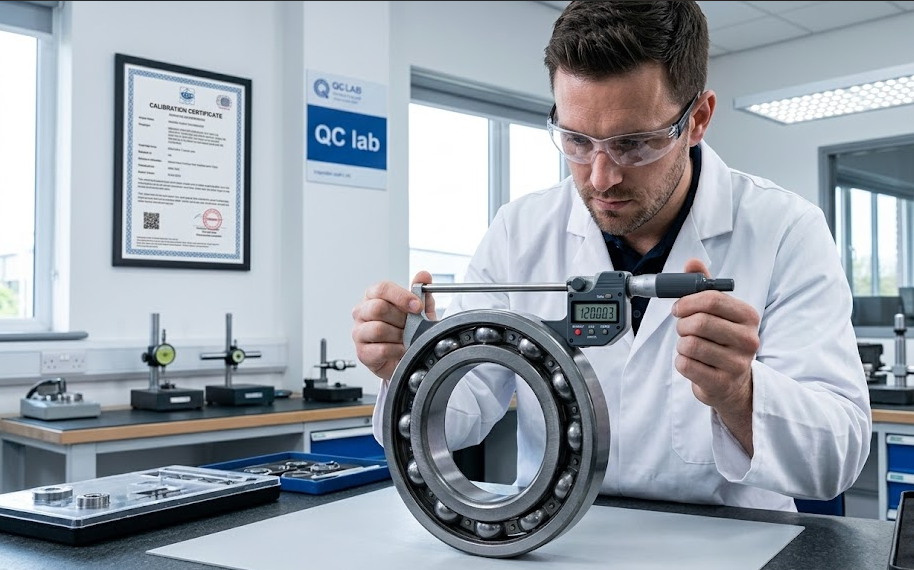
Visit their warehouse. Do they have calibrated callipers, micrometres, hardness testers, and thread gauges? Incoming inspection is the first defence against bad parts.
5. Sample Approval Process
A professional supplier sends first-article samples for your approval before mass production. They keep the approved sample as a reference for future batches.
6. Pricing Transparency
Request a breakdown: raw material cost, machining cost, surface treatment, packaging, GST, and freight. Hidden charges are a red flag.
7. After-Sales Support
What happens when a component fails prematurely? Do they replace it within 30 days? Do they investigate root cause? A good industrial components supplier stands behind every part.
That is the real value of a quality industrial components supplier. The extra ₹3 per fastener costs you an additional ₹7,500 per month in purchase price. The saving in rework alone is 10× that amount.
“We used to buy components from three different traders. One for fasteners, one for bearings, one for fittings. Every week, we chased deliveries and fought about quality. Then we consolidated with DK Tooling as our single industrial components supplier. Now, one purchase order covers 80% of our needs. Lead times dropped from 12 days to 3 days. And when a bearing failed prematurely, they replaced it within 48 hours – no arguments. That is partnership.” — Vikram J., Procurement Head, Hydraulic Equipment Manufacturer, Faridabad
How to Select Best Industrial Components Supplier That Keeps Your Production Running 11
Frequently Asked Questions
Q1: What is the difference between an industrial components supplier and a regular hardware shop?
A hardware shop sells to walk-in customers for general repairs. An industrial components supplier serves factories with bulk quantities, material certifications, technical data sheets, and consistent quality. Hardware shops cannot provide traceability or batch-level documentation. For production use – where a failed component stops a line – you need an industrial supplier, not a local shop.
Q2: How do I verify that a component is genuine and not counterfeit?
Counterfeit bearings and fasteners are common in India. Ask for the manufacturer’s original packaging with batch numbers. Request a material test certificate from an NABL-accredited lab. For bearings, genuine ones have laser-etched markings that are crisp and deep; counterfeits have shallow or blurred printing. Also measure critical dimensions – counterfeit components often fail tolerance checks. A trustworthy industrial components supplier provides all this documentation without hesitation.
Q3: What is your typical MOQ for standard components like fasteners or bearings?
For standard fasteners (M2–M20), MOQ is usually one box (100–500 pieces depending on size). For bearings, MOQ is one piece for common sizes (6200 series, 6300 series). For less common sizes or special materials (e.g., stainless steel 316), MOQ may be 10–20 pieces. Custom machined components have MOQ starting at 50 pieces. Contact our team for exact numbers – we often combine items to reach a fair MOQ.
Q4: Can you supply components for legacy equipment no longer in production?
Yes. Many Indian factories run older European, Japanese, or American machines. We can source or reverse-engineer obsolete components. Provide a sample or a detailed drawing with critical dimensions. For bearings, the number on the seal (e.g., 6204-2RS) is sufficient. For fasteners, tell us the thread size (e.g., M12×1.75), length, and grade. Lead times for obsolete items range from 5 to 25 days depending on complexity.
Q5: What certificates should I ask for when buying fasteners for structural use?
For critical structural fasteners (bridges, cranes, heavy machinery), require: (1) Material test certificate showing chemical composition and tensile strength, (2) Certificate of conformity to grade (e.g., Grade 10.9 or 12.9), (3) Batch number linking to production records, (4) Third-party inspection report if specified by your customer. A professional industrial components supplier maintains these records for every batch sold. Never accept “we can provide a general certificate” – that is a red flag.
Q6: How do you handle emergency orders when a machine breaks down?
We reserve a portion of our stock for emergency support. Call our emergency helpline (available 8 AM to 10 PM, Monday–Saturday). For critical components, we can dispatch within 2 hours from our Mumbai warehouse. Same-day delivery is possible within Maharashtra, Gujarat, and parts of Karnataka. For other states, overnight courier is standard. Emergency orders carry a small premium (10–20%) to cover express logistics. Many customers find this cheaper than holding excess safety stock.
Q7: What is the warranty on industrial components?
Standard warranty is 30 days against manufacturing defects. For bearings from premium brands (SKF, FAG, NBC), the manufacturer’s warranty applies (typically 12 months). For custom machined components, we warranty dimensional accuracy to your drawing. Warranty does not cover misuse, incorrect installation, or normal wear. If a component fails prematurely, we investigate. If the fault is ours – wrong material, incorrect heat treatment, or dimension outside tolerance – we replace it free of charge and cover reasonable courier costs.
Conclusion
Your production line is a chain of promises. Every component – every fastener, bearing, fitting, and pin – makes a promise to perform. When one breaks that promise, the whole chain weakens.
Choosing the right industrial components supplier is not about finding the lowest price. It is about finding a partner who stocks the right parts, inspects them before dispatch, provides documentation you can trust, and answers the phone when you need help.
DK Tooling has served Indian manufacturers for over 15 years. We stock thousands of standard components in our Mumbai warehouse. We manufacture custom parts to your drawings. We stand behind every component we sell.
Stop chasing unreliable suppliers. Start building a dependable supply chain.
Download our catalogue, request a quote, or speak to our component specialists today.














You must be logged in to post a comment.