

The Best Guide to Threaded Fasteners for Industrial Tooling Applications
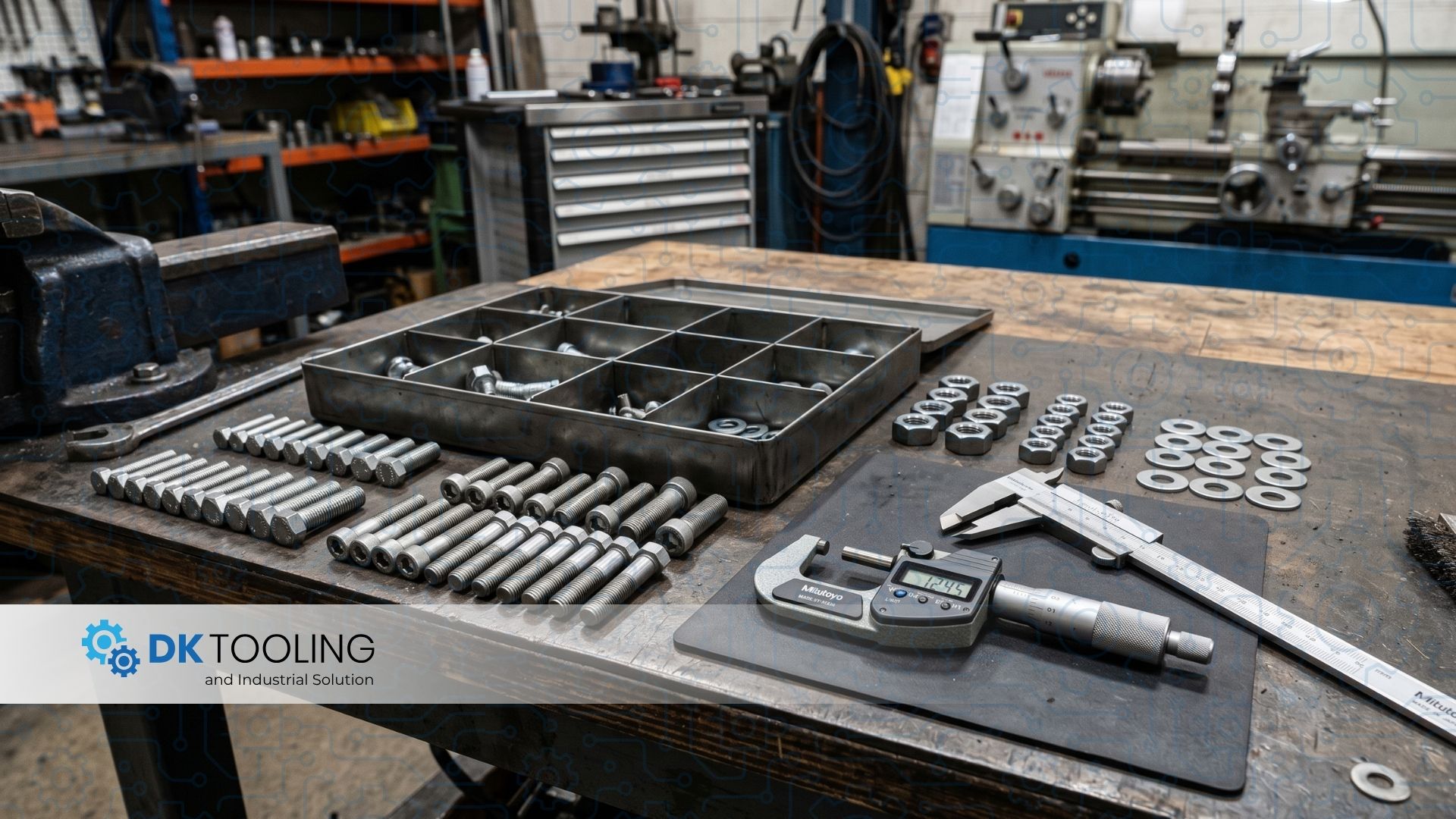
Stop for a moment on your shop floor and look at the machines, fixtures, and structural frames around you. Nearly every assembly relies on small, precisely engineered components that hold everything together—threaded fasteners.
When a critical bolt snaps on a stamping press or a stainless steel screw corrodes prematurely in a food-grade fixture, the cost is measured in downtime, lost production, and sometimes safety incidents. This guide gives you the deep technical knowledge and practical selection advice you need to get your fastener choices right the first time, every time.
1. What Are Threaded Fasteners?
Threaded fasteners are mechanical components that use a helical ridge—the thread—to join two or more parts together. The family includes bolts, screws, nuts, studs, and washers, each designed for specific loading conditions and assembly environments. In industrial tooling, you encounter them on jig and fixture plates, injection mould platens, cutting tool holders, conveyor frames, and hydraulic power unit mounts.
These components work by converting rotational tightening torque into a strong clamping force. The thread profile, pitch, and material all influence how much load the fastener can carry without loosening or breaking.
For tooling applications, where vibration, thermal cycles, and cutting forces are everyday realities, selecting the right threaded fasteners is not a commodity purchase—it’s a precision engineering decision.
A correctly specified grade 12.9 socket head cap screw on a CNC tombstone fixture can hold 0.01 mm flatness over thousands of cycles, while a poor-quality substitute can relax, shift, and cause dimensional scrap.
2. Main Types of Threaded Fasteners and Their Applications
The world of industrial fasteners is broad. The table below summarises the most common types of threaded fasteners you’ll specify in a tooling environment.
| Fastener Type | Best Use Case | Typical Material Options | Price Range (INR/piece) |
|---|---|---|---|
| Hex Head Bolt | Structural frames, heavy machinery bases | Carbon Steel 8.8 / 10.9, Stainless Steel A2-70 | ₹8 – ₹250 (M6–M24) |
| Socket Head Cap Screw | Fixture clamps, mould plates, tight-space tooling | Alloy Steel 12.9, Stainless Steel A4-80 | ₹5 – ₹180 (M3–M20) |
| Studs (Both Ends Threaded) | Cylinder head mounts, large die sets | Alloy Steel, Duplex Stainless | ₹20 – ₹500+ |
| Hex Nut | Matches with bolts; used with washers | Carbon Steel 8, Stainless Steel A2 | ₹1 – ₹30 |
| Washer (Flat & Spring Lock) | Load distribution and vibration resistance | Spring Steel, Stainless 304 | ₹0.50 – ₹10 |
| Self-Tapping Screw | Sheet metal enclosures, control panels | Case-hardened Steel, A2 Stainless | ₹2 – ₹15 |
| Grub / Set Screw | Collar locking, pulley hubs on shafts | Alloy Steel 45H, Stainless | ₹3 – ₹35 |
| Threaded Rod | Custom-length studs, hanging supports, bracing | B7 Alloy, A2-70 Stainless | ₹150 – ₹800 per metre |
This table covers the main categories, but within each, you will find sub-types like flanged hex bolts, button head screws, or nyloc nuts. For tooling that must withstand high dynamic loads, socket head cap screws in 12.9 grade are the preferred choice.
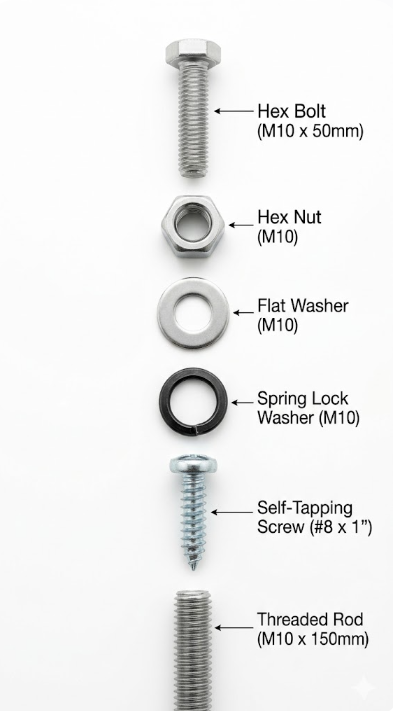
For corrosive washdown areas, stainless steel threaded fasteners in A4-80 grade give you strength combined with excellent chemical resistance.
3. Material Grades: Stainless Steel, Alloy, and Carbon Steel
Material selection is where many procurement errors begin. Using the wrong grade leads to rust, galling, or sudden failure. Here’s what you need to know.
Carbon Steel Fasteners (Grades 4.6, 8.8, 10.9, 12.9):
These are the workhorse materials for general industrial use. Grade 8.8 is suitable for most structural applications with moderate strength needs. For high-stress tooling, grade 12.9 alloy steel offers tensile strength above 1,200 MPa.
The trade-off is lower corrosion resistance, so zinc plating or zinc-nickel plating is necessary unless you are in a dry indoor environment. Black threaded fasteners often refer to those with a black oxide finish, which gives mild corrosion protection and reduces glare in optical setups but is not suitable for outdoor or wet conditions.
Stainless Steel Fasteners (A2, A4, Duplex):
A2 (304) stainless is the general-purpose choice for food, pharmaceutical, and moderate chemical environments. A4 (316) adds molybdenum for better chloride resistance—important for coastal or heavily sanitised tooling.
However, stainless fasteners have lower yield strength compared to 12.9 alloy steel and are prone to galling during assembly. Always use a suitable anti-seize lubricant and reduce tightening speed. Stainless steel threaded fasteners are available in male (bolts, screws) and female (nuts, threaded inserts) configurations to suit your design.
Specialty Alloys – Brass, Titanium, and Super Duplex:
Brass fasteners appear in electrical switchgear and instrument mountings for their non-magnetic properties. Titanium offers corrosion immunity and light weight, but the cost (often ₹1,500+ per M10 bolt) limits it to aerospace-derived tooling. Super duplex stainless combines high strength with extreme corrosion resistance, ideal for subsea or chemical plant tooling.
4. Thread Standards and Sizing Explained
One of the most frustrating experiences for a buyer is receiving threaded fasteners that don’t mate with the tapped holes on an imported machine. Thread standards vary globally, and mixing them is dangerous.
- Metric (ISO) – Used across India and Europe. Coarse pitch is standard (e.g., M10 x 1.5), fine pitch (e.g., M10 x 1.25) is used where vibration resistance is critical.
- Unified (UNC/UNF) – Common on US-made or older UK equipment. A ½-13 UNC bolt looks similar to an M12 but will bind if forced.
- BSP/BSPT – Threaded pipe fasteners, often encountered in fluid connections on tooling.
- BA, Whitworth – Legacy threads seen on vintage machine tools in many Indian workshops.
When you need to know the size threaded fasteners for a job, always measure the major diameter with a Vernier caliper and check the pitch with a thread pitch gauge. Don’t rely on visual comparison. If you’re sourcing online threaded fasteners, look for suppliers that provide clear dimension tables.
A typical product page should list thread diameter, pitch, length under head, head type, and drive size. For female threaded fasteners like nuts and threaded inserts, the internal thread size and class of fit (e.g., 6H) matter greatly in high-vibration tooling to prevent loosening.
5. How to Choose the Correct Threaded Fastener
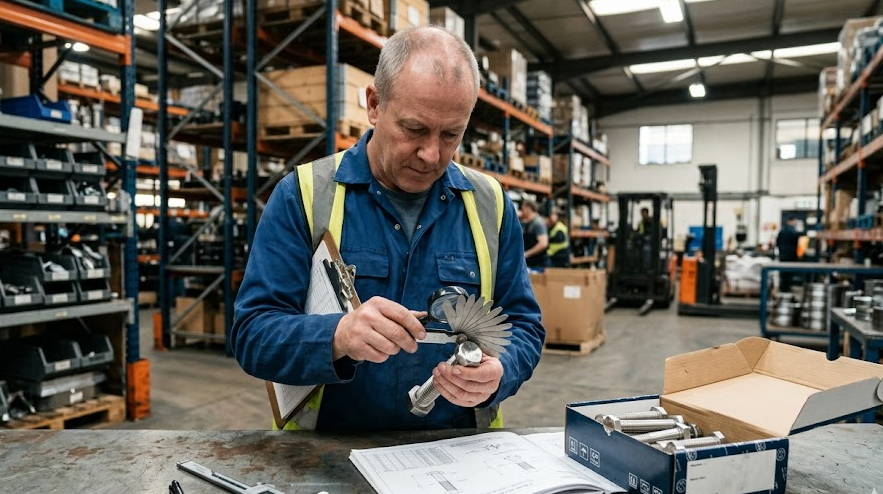
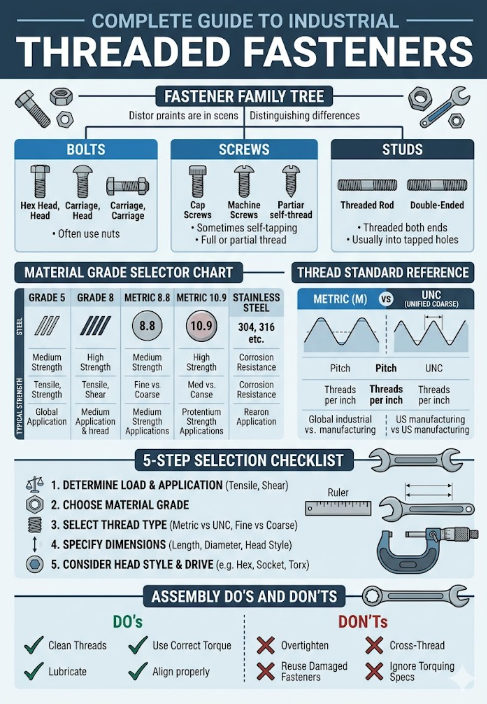
Selecting the right fastener involves more than matching a thread size. When you buy threaded fasteners, work through this five-point checklist.
- Load & Strength Requirement – Calculate the static tensile load, shear load, and any bending. Choose a grade that provides at least a 3:1 safety factor against yield. For a horizontal machining centre fixture plate, you may need 12.9 cap screws at torque levels around 80–100 Nm for an M12.
- Environmental Exposure – Will the fastener see coolant, washdown chemicals, or outdoor humidity? For anodised aluminium tooling, use A2-70 stainless or zinc-plated steel with a protective cap to prevent galvanic corrosion where the two metals meet.
- Repeated Assembly / Disassembly – Fixtures that are changed daily require fasteners that can handle multiple torque cycles without deforming the threads or socket. Helicoil or threaded inserts in aluminium plates are essential here.
- Locking Mechanism – For continuous vibration, you need mechanically locking fasteners. Nyloc nuts, prevailing torque nuts, wedge-lock washers, and thread-locking fluid (e.g., Loctite 243) are your options. Note that nylon inserts in nyloc nuts soften above 120°C; for hot tooling, all-metal lock nuts are better.
- Head Type and Access – Confined tooling often demands low-head or button-head socket screws. Be aware that the reduced socket depth limits torque transmission; a stripped hex socket on a mould plate can halt production for hours.
Expert Quote: “Selecting the correct industrial threaded fastener improves assembly efficiency, worker safety, and machine lifespan. With the right grade and coating, you eliminate 90% of unplanned maintenance caused by loose joints.” – Ramesh K., Senior Tooling Engineer.
6. Installation Best Practices and Torque Control
Even the finest hex threaded fasteners will fail if they are installed incorrectly. The joint’s reliability depends on achieving a precise clamping force through controlled torque or angle tightening.
Use a calibrated torque wrench, not an impact gun, for critical joints. For a grade 12.9 M10 fastener, the recommended dry torque is approximately 55–60 Nm, while a lubricated thread might require only 40–45 Nm to achieve the same preload. The reduction in friction from lubrication can lead to over-tightening if you use dry torque values. Always check your supplier’s torque charts and specify whether lubricant is used.
For self-tapping threaded fasteners in sheet metal panels, the drill tip must match the total material thickness. Use a depth-controlled screwdriver to avoid stripping the newly formed threads. When installing threaded rod fasteners, always cut the rod square with a proper rod cutter, chamfer the end, and use two nuts jammed together to insert it cleanly without damaging the thread.
In high-vibration tooling, torque alone is not enough. Use secondary locking: a flange bolt with serrations, a spring lock washer combined with a flat washer, or pre-applied threadlocker patches. Record installed torque values on a setup sheet; it helps a night-shift operator verify that no fastener has loosened.
7. Common Buyer Pain Points (and Practical Solutions)
Purchasing and engineering teams face consistent challenges when they source threaded fasteners.
Here are the most frequent pain points and how to solve them.
- Identifying what’s in stock quickly: Workshop stores often have bins of mixed bolts without labels. Solution: Use drawer cabinets with identification tags showing part number, thread size, material, and strength class. Digital photos of each item help junior staff match what they see.
- Hidden costs of cheap fasteners: A ₹3 bolt that shears inside a ₹15,000 fixture part generates huge rework costs. Stick to branded or ISO-certified sources for threaded fasteners under 1500 Rupee packs and verify test certificates for high-grade batches.
- Mismatched thread standards on imported tooling: A machine from Italy may use metric fine threads, while a Japanese jig uses JIS standard M10 coarse with a slightly different head height. Keep a thread ID kit and an adapter inventory.
- Long lead times for non-standard sizes: Custom-length socket head screws or special alloy studs can delay projects. Partner with a supplier who can machine specialised threaded fasteners from stock blanks within 48 hours.
- Surface finish and colour issues: Some buyers specifically search for white threaded fasteners (colour-coded for specific torque specs in some factories) or red threaded fasteners (identification on hydraulic manifolds). Work with a supplier that offers plating, anodising, or polyester coating for colour coding.
- Online ordering confusion: When searching on platforms like justdial.com threaded fasteners, amazon.in threaded fasteners, or flipkart threaded fasteners, you may face incomplete descriptions or mixed batches. Specialist industrial portals like makerbazar.in threaded fasteners or elesa-ganter.in threaded fasteners often provide better technical data and traceability.
8. Recommended Threaded Fastener Products
Based on our experience supplying Indian tooling houses, these are five products we frequently recommend. They represent the right balance of quality, availability, and cost.
Products by Tag
-
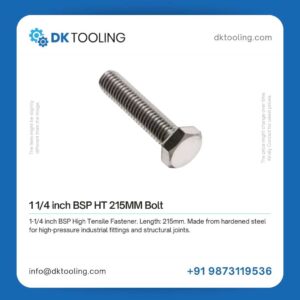
1 1/4 inch BSP HT 215MM Bolt
Original price was: ₹650.00.₹550.00Current price is: ₹550.00. -
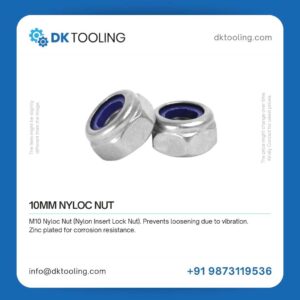
10MM NYLOC NUT
Original price was: ₹13.00.₹11.00Current price is: ₹11.00. -
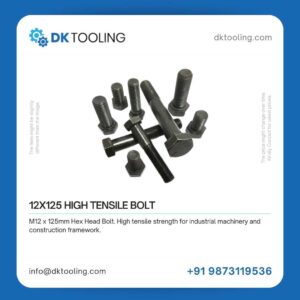
12X125 HIGH TENSILE BOLT
Original price was: ₹78.00.₹66.00Current price is: ₹66.00. -
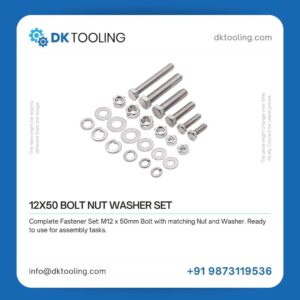
12X50 BOLT NUT WASHER SET
Original price was: ₹52.00.₹44.00Current price is: ₹44.00. -
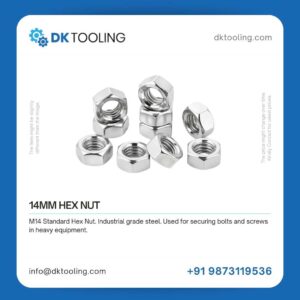
14MM HEX NUT
Original price was: ₹19.00.₹16.00Current price is: ₹16.00. -
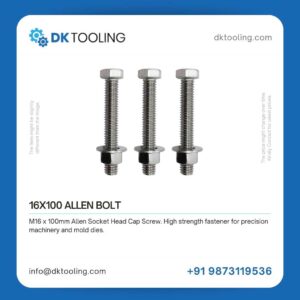
16X100 ALLEN BOLT
Original price was: ₹91.00.₹77.00Current price is: ₹77.00. -
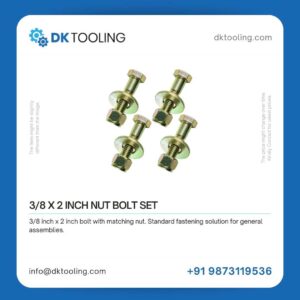
3/8 X 2 INCH NUT BOLT SET
Original price was: ₹26.00.₹22.00Current price is: ₹22.00. -
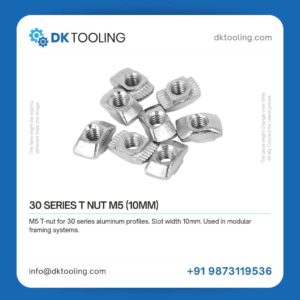
30 SERIES T NUT M5 (10MM)
Original price was: ₹13.00.₹11.00Current price is: ₹11.00. -
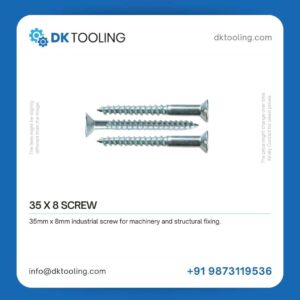
35 X 8 SCREW
Original price was: ₹65.00.₹55.00Current price is: ₹55.00.
9. Related Products You May Also Need (Cross-Sell)
To complete your fastener assembly correctly, add these accessories and consumables.
Products by Tag
-
12X50 BOLT NUT WASHER SET
Original price was: ₹52.00.₹44.00Current price is: ₹44.00.
10. Frequently Asked Questions
1. How do I measure the size of an existing threaded fastener to order a replacement?
Use a digital Vernier caliper to measure the major diameter of the external thread (for a bolt or screw) or the minor diameter of the nut if it’s a female fastener. Then determine the thread pitch: if it’s a metric bolt, measure the distance from one thread crest to the next in millimetres (e.g., 1.5 mm for M10 coarse). For imperial threads, count the number of crests in one inch.
Compare your measurements against a standard thread chart, which lists all common dimensions threaded fasteners will have. If you lack measuring tools, take a clear photograph alongside a ruler and send it to your supplier. Never try a bolt in a tapped hole by force—cross-threading can ruin the female thread, especially in cast iron or aluminium.
Also check the head marking: grade symbols (8.8, 12.9, A2-70) are stamped on the top, telling you the material and strength class. This is critical because buying the same size in a weaker grade could cause failure.
2. What is the difference between male threaded fasteners and female threaded fasteners?
Male threaded fasteners have the thread on the outside surface: bolts, screws, studs, and threaded rod. They pass through or into a component and mate with a female threaded part. Female threaded fasteners have the thread on the inside: nuts, threaded inserts, and tapped holes in a housing. A complete joint often uses both: a hex bolt (male) with a hex nut (female) and a washer.
In tooling, you also encounter female threaded fasteners like weld nuts, rivet nuts, and helicoils. Helicoils are stainless steel wire inserts that create strong female threads in soft parent materials such as aluminium jig plates.
When buying, specify both the male and female parts clearly—saying “M10 threaded fasteners” could mean a bolt, a nut, or both. Providing a sketch or a part code that separates male/female eliminates ambiguity.
3. Are stainless steel threaded fasteners always the best choice for every application?
Not always. Stainless steel offers excellent corrosion resistance, but it has lower tensile and yield strength compared to heat-treated carbon and alloy steels. An A2-70 stainless bolt has a minimum tensile strength of 700 MPa, while a 12.9 alloy cap screw exceeds 1,200 MPa.
If your tooling demands high preloads in a compact space, stainless may not provide the required margin. Additionally, stainless fasteners are susceptible to galling—a seizure of the threads during tightening, especially with nyloc nuts or fine threads.
You can mitigate this with anti-seize, but it adds a process step. For dry indoor tooling environments where strength and cost matter most, zinc-plated carbon steel is often the better choice. Reserve stainless steel threaded fasteners for applications that see moisture, chemical washdown, or require magnetic-free properties.
4. Can I use self-tapping threaded fasteners in any sheet metal application?
Self-tapping screws create their own threads in the base material, eliminating the need for a pre-tapped hole or nut. They are ideal for control panel assembly, thin gauge steel guards, and cable management clips. However, you must match the screw’s drill point to the material thickness.
For steel up to 1.5 mm, a standard ST-type screw works well. For thicker steel or aluminium, consider thread-forming or thread-rolling screws that displace material rather than cutting it, giving stronger holding torque. Avoid re-using self-tapping threaded fasteners in the same hole more than two or three times, as the thread can weaken.
If repeated access is needed, install a rivet nut instead and switch to a conventional machine screw. In tooling, self-tappers are rarely used on critical structural joints—they’re best for ancillary features like guarding, cable trunking, and sensor brackets.
5. How do I prevent threaded fasteners from loosening under vibration on my CNC machines?
CNC machine tooling and fixtures experience constant high-frequency vibration. The first defence is correct preload: a properly torqued joint resists loosening because the clamping force keeps the mating surfaces locked together.
If vibration loosening persists, add a mechanically locking element. Wedge-lock washers (Nord-Lock style) use matched pairs with serrated faces that lock into each other; they are extremely reliable on tombstone fixtures. All-metal prevailing torque lock nuts with a distorted thread section grip the bolt threads without temperature limitations.
Thread-locking adhesives (anaerobic) are also effective, but they must be applied to clean, dry threads. For joints that need frequent disassembly, use medium-strength threadlocker (blue). Avoid reuse of nyloc nuts in high-temperature areas above 120°C. Combining a flange bolt with a wedge-lock washer often eliminates loosening without needing adhesive.
6. What do colour-coded threaded fasteners like black, white, or red indicate?
Black threaded fasteners usually have a black oxide coating for mild corrosion resistance and anti-glare. They are common in camera mounts, optical alignment tooling, and general internal machine parts.
White threaded fasteners sometimes indicate a PTFE or fluoropolymer coating for chemical resistance and non-stick properties, or they could be colour-coded bolts used in a specific torque sequence by a machine builder. Red threaded fasteners often denote a pre-applied nylon locking patch (red Loctite patch) that provides high-strength threadlocking without needing liquid adhesive.
In some factories, red painted bolt heads serve as a visual indicator that the bolt has been torqued and checked. Never assume a colour tells you the grade; always verify the head marking or test certificate. Coloured fasteners should be specified clearly in your purchase order to avoid receiving the wrong finish.
7. I need threaded fasteners urgently—what’s the fastest way to get them online in India?
When you search for online threaded fasteners on a platform like justdial.com threaded fasteners or amazon.in threaded fasteners, you’ll get a wide listing but may struggle with technical details or bulk pricing.
For critical tooling, use industrial B2B suppliers with technical support. Search terms like buy threaded fasteners or threaded fasteners nearby can point you to local industrial hardware distributors who offer will-call pickup. If you are in a specific region, adding a city—like threaded fasteners chennai or threaded fasteners pune—narrows results to physical stockists.
For niche items, specialist platforms such as makerbazar.in threaded fasteners or elesa-ganter.in threaded fasteners provide technical datasheets and guaranteed traceability. Always check the minimum order quantity, lead time, and whether the listing shows test certificates before placing an urgent order.
8. What is the difference between threaded and non-threaded fasteners?
Threaded fasteners use a helical thread to clamp components together; they are disassemblable and reusable. Examples include bolts, nuts, screws, and studs. Non threaded fasteners include rivets, retaining rings, pins (dowel, clevis, spring pins), keys, and press-fit inserts.
In tooling, rivets may be used for permanently joining sheet metal guards, while dowel pins accurately locate fixture plates. The advantage of threaded fasteners is they allow disassembly for maintenance, adjustment, or replacement. However, in some high-purity or extreme vibration environments, the thread itself can be a source of contamination or loosening.
Engineers balance the need for serviceability against permanence. Often, a tooling assembly combines both: dowel pins for precise positioning and threaded fasteners for clamping.
11. Final Thoughts and Next Steps
Threaded fasteners are fundamental to every industrial tooling installation, yet they are often treated as an afterthought. When you give them the same engineering attention as your cutting tools or hydraulic components, you gain more reliable uptime, safer work conditions, and lower overall costs.
Whether you need a high-tensile socket head cap screw for a mould clamp, a corrosion-resistant stainless stud for a pharma line, or a colour-coded bolt for a visual torque-check system, the right choice is out there.
Posts Widget
-
1
-
2
-
3
-
4


dk-tooling-logo-horizontal-inverse
DK Tooling and Industrial Solution
Welcome to DK Tooling, your trusted partner in precision tooling and manufacturing solutions. With decades of experience in the industry, we specialize in providing high-quality, reliable tooling solutions for a wide range of sectors, including automotive, aerospace, medical, and consumer goods.
Copyright 2025 © Partdo WordPress Theme. All right reserved. Powered by KLBTheme.



You must be logged in to post a comment.